Few words possess as much moral prestige in our society as the word choice.
Truth can be controversial. Justice can be debated. Even love occasionally attracts the critique of cynics. But choice? Choice is quite untouchable.
This is especially evident in the abortion debate. Supporters of abortion rights often describe themselves as “pro-choice,” a term that carries an immediate positive appeal. After all, who wants to be against choice?
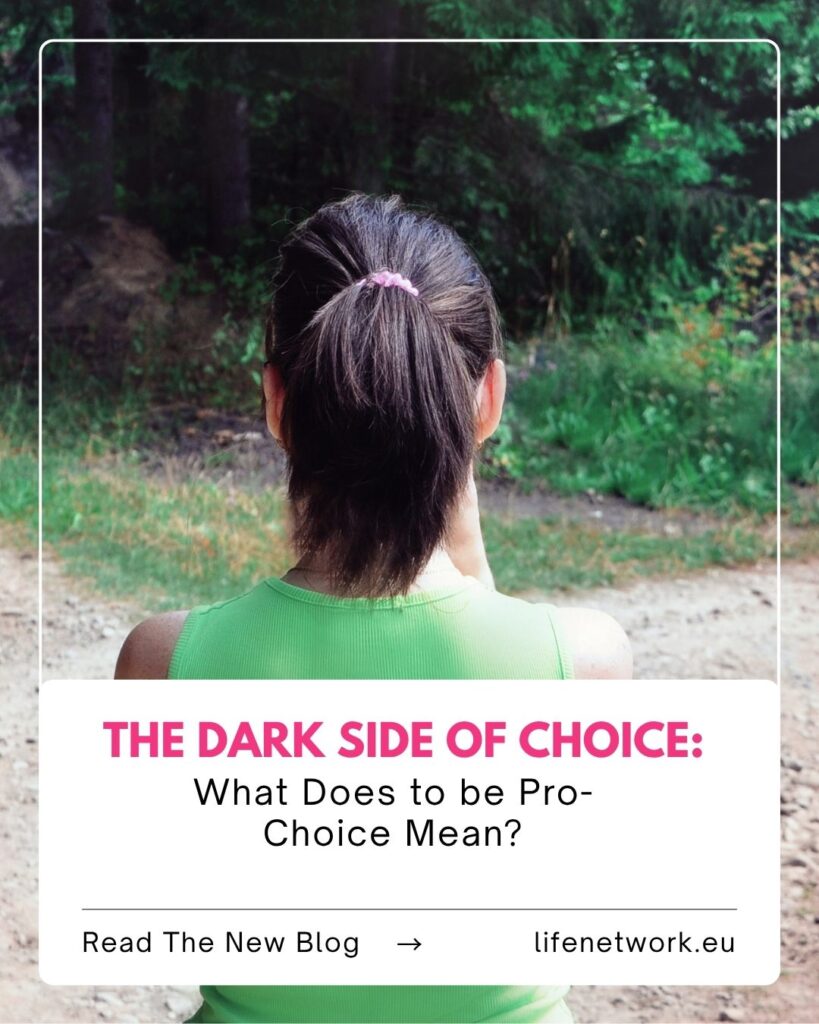
What Does to be Pro-Choice Mean
At first glance, the answer appears obvious. To be ‘pro-choice’ means supporting a woman’s right to choose whether to continue a pregnancy.
But notice something interesting. The word “choice” immediately directs our attention to the person making the decision. It tells us who is choosing. It does not tell us what is being chosen, nor does it tell us who may be affected by that choice.
That is why the phrase is so powerful. It frames the discussion in terms of freedom while quietly shifting attention away from the object of the choice itself.
The reality is that choice, by itself, is not a moral argument.
We choose hundreds of things every day. We choose what to eat, where to work, whom to marry and what to believe. The mere existence of a choice does not tell us whether the choice is right or wrong. It simply tells us that a decision is being made.
Imagine somebody saying, “I support people’s right to choose.”
The obvious response would be: “Choose what?”
Because no serious society has ever believed that every choice is automatically good simply because it is chosen.
We do not have the right to choose to steal from our neighbour. We do not have the right to choose violence against innocent people. We do not have the right to choose reckless behaviour that puts others in danger.
This is not because freedom is unimportant. It is because freedom has always existed alongside responsibility. In fact, civilisation itself depends upon recognising that our choices affect other people.
In fact, the moment another person enters the picture, choice is no longer the only value in the room.
And this brings us back to abortion.
One of the strangest features of the abortion debate is that it is presented as though there is only one person whose interests deserve consideration.
Yet everyone knows there are two human beings involved. Two human beings who are both fully human – because humanity does not depend upon size, age, or intelligence. It simply depends on human DNA – and this is uniquely present in both mother and baby.
This means that the question is not simply whether a woman has a choice. But whether one person’s choice extends to another person’s life. That is a very different discussion.
What is particularly striking here is that the language of choice often excludes the one individual who has the most at stake. The woman chooses. The doctor chooses. The politician chooses. The activist chooses.
Everyone is talking about choice.
Except the unborn child.
But of choice is such a fundamental value, why does it suddenly disappear when another human being enters the equation?
Supporters of abortion often speak as though the alternative to abortion is the denial of choice. But this is false. A woman who continues her pregnancy has not ceased to make choices.
She chooses whether to raise the child herself. She chooses whether to seek support from family and friends. She chooses whether to pursue adoption. She chooses countless things about her future and her child’s future.
The birth of a child does not end choice. It simply places those choices within the context of another human life.
And that is precisely how freedom operates everywhere else in society. Parents cannot choose to neglect their children. Business owners cannot choose to exploit their employees. Citizens cannot choose to ignore the rights of their neighbours. The presence of another human being creates responsibilities. Why should the unborn child be the exception?
This reveals the dark side of choice.
Not choice itself, but the way the word can be used. Sometimes a beautiful word can hide a difficult reality. Sometimes a slogan can simplify a question that deserves deeper reflection. And sometimes the language of freedom can become a way of avoiding the question of responsibility.
The real issue in the abortion debate is not whether women should have choices. Of course they should. Human freedom is one of the most precious things we possess.
The real question is whether freedom includes the right to decide which human beings count and which do not.
Because when choice becomes detached from responsibility, it ceases to be freedom in its fullest sense. It becomes tyranny. That is why the abortion debate cannot be resolved simply by appealing to choice. Choice matters. But so does the life of the baby; whom is no less human than that of the mother. And a truly humane society should be human enough to care about both.
Stay Connected. Make an Impact.
If this post moved you, don’t stop here.
- Sign up to receive updates and see how lives are being changed.
- Support our work by making a donation—every gift helps us reach more mothers, protect more children, and speak up for life.
Together, we’re building a culture that values every life.
Thank you for being part of it.
What Does to be Pro-Choice Mean
What Does to be Pro-Choice Mean What Does to be Pro-Choice Mean What Does to be Pro-Choice Mean What Does to be Pro-Choice Mean